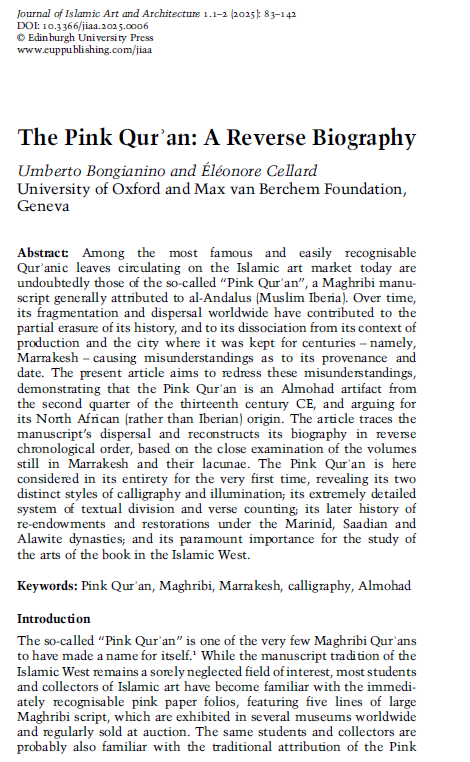
I am delighted to announce the publication of an article I co-authored with Umberto Bongianino, titled “The Pink Qurʾan: A Reverse Biography”, in the Journal of Islamic Art and Architecture: 🔗 https://www.euppublishing.com/doi/abs/10.3366/jiaa.2025.0006
Unfortunately, the paper is not open-access, but I would be happy to share a copy upon request.
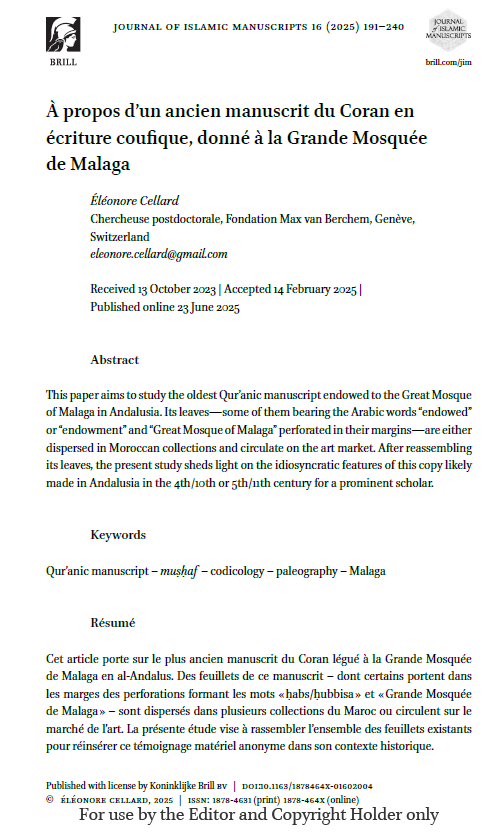
I’m thrilled to announce the publication of my first article on Moroccan Qur’an manuscripts in the Journal of Islamic Manuscripts 16(2), 191-240. 📄 Title: À propos d’un ancien manuscrit du Coran en écriture coufique, donné à la Grande Mosquée de Malaga (On an Early Qur’anic Manuscript in Kūfī Script Given to the Great Mosque of Malaga) 🔗 Read the article here
Abstract: This paper examines the oldest Qur’anic manuscript endowed to the Great Mosque of Malaga in al-Andalus. Its leaves—some of which bear the Arabic words “endowed” (waqf) or “endowment” and “Great Mosque of Malaga” perforated in their margins—are now dispersed across Moroccan collections and occasionally appear on the art market. By reassembling its scattered folios, the study highlights the distinctive features of this copy, likely produced in al-Andalus in the 4th/10th or 5th/11th century for a prominent scholar.
Feel free to reach out if you’d like to learn more about this research!
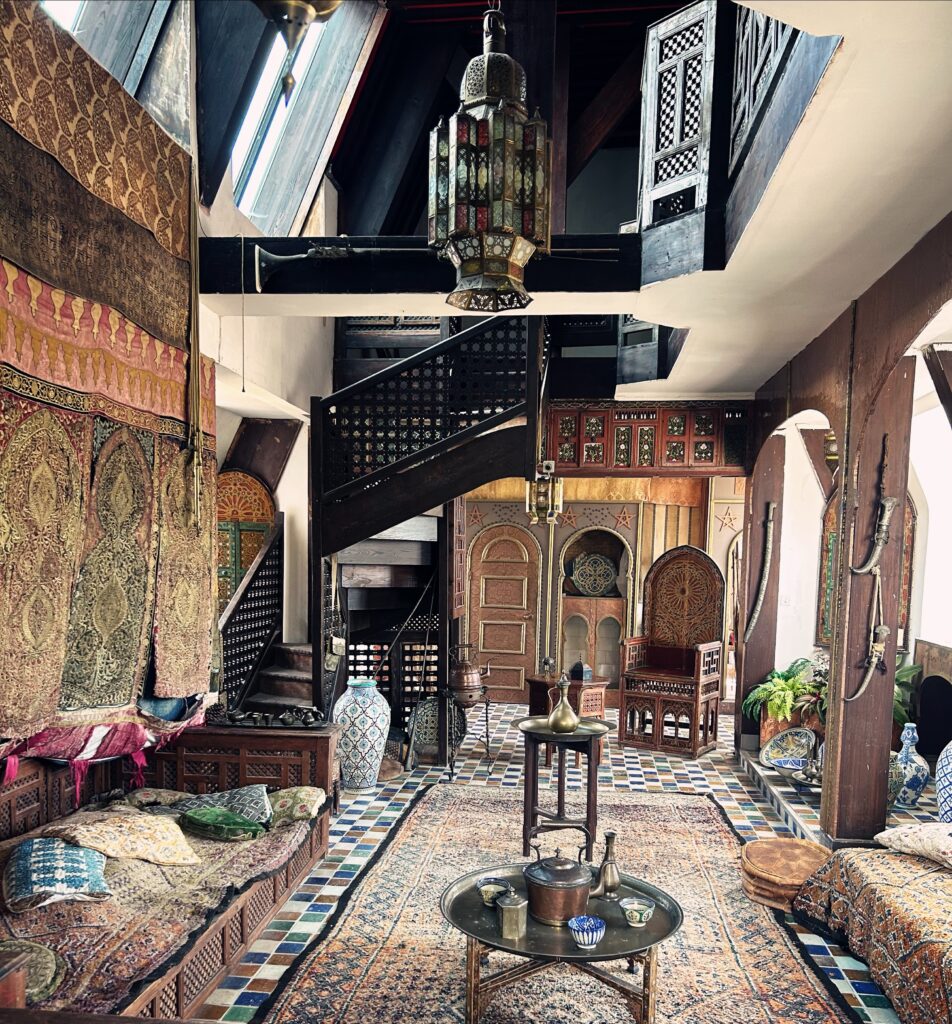
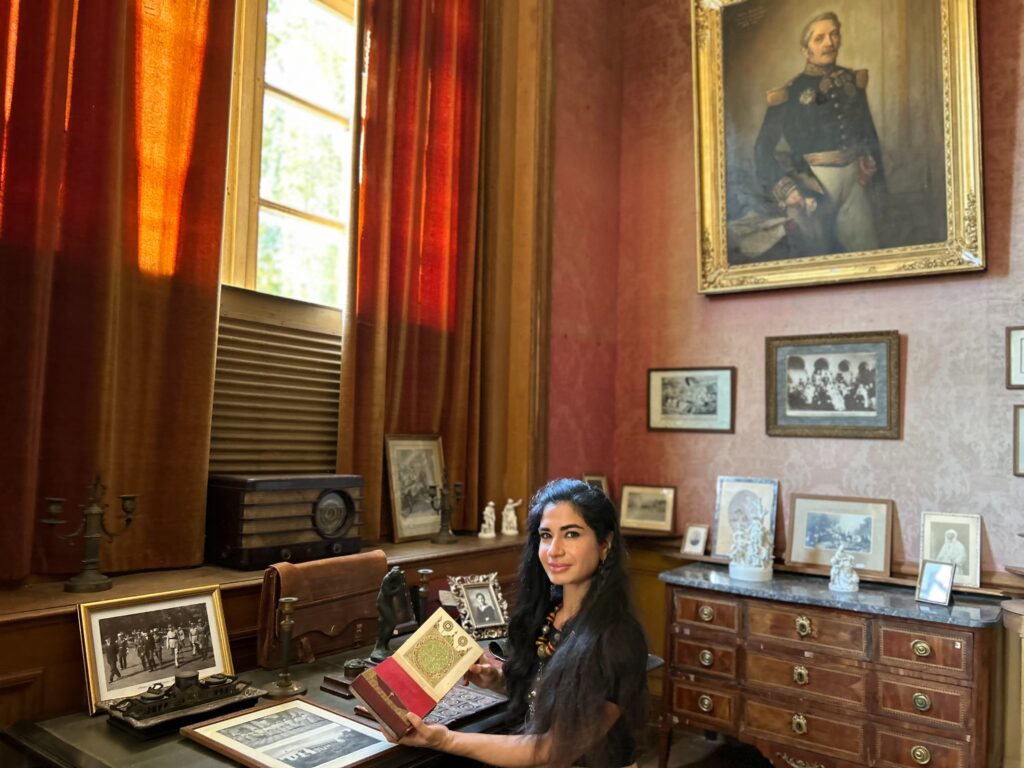
This past July 5 and 6, I had the great honor of visiting Marshal Lyautey’s château in Lorraine. Resident-General of France in Morocco (1912–1925), Lyautey was not only a statesman, but also a passionate admirer of Moroccan art and culture. His château houses an extraordinary collection of Moroccan artifacts, books, and personal objects — a rare and powerful testimony to a century-old relationship between France and Morocco.
This unique heritage is now in the care of the Fondation Lyautey, a small group of passionate volunteers working to preserve both the château and its remarkable collections.But this legacy is fragile — and needs greater visibility and support.
If you believe in the importance of protecting cultural heritage and honoring shared history, I invite you to discover and support the work of the Fondation Lyautey: https://lyautey.fr/fondation/
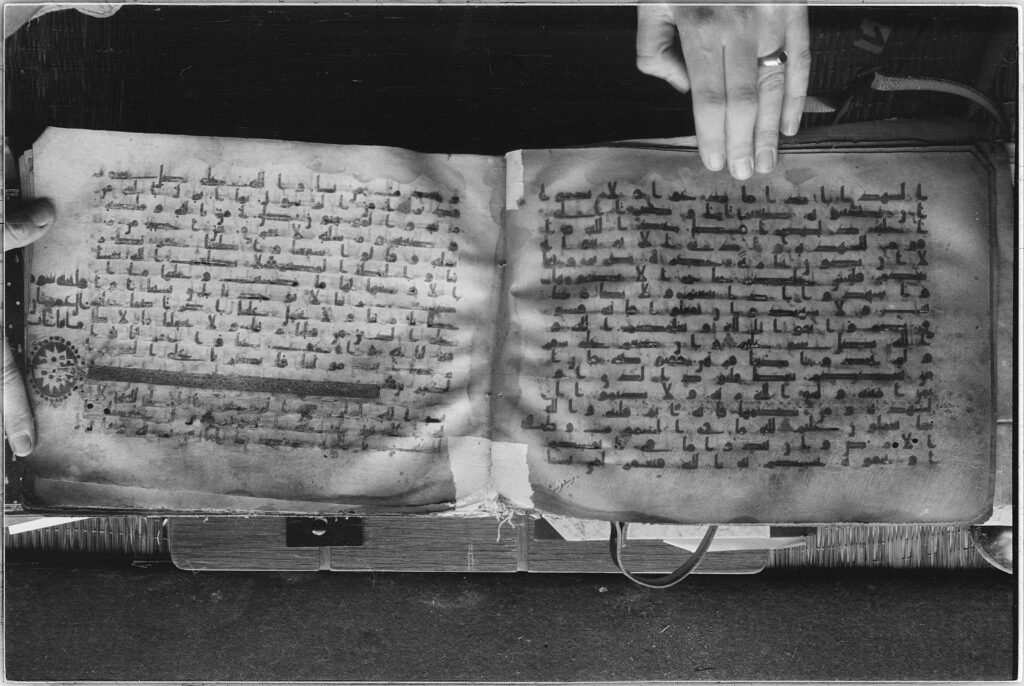
The Odyssey of the oldest Qur’an in the Royal Library of Morocco with Dr. Éléonore Cellard explores the history of Morocco’s oldest preserved Qur’anic manuscript—a rare, single-volume codex written in Kufic script and dating back to the 2nd AH / 8th century CE. Likely of Eastern origin and sometimes attributed to Caliph ‘Uthman ibn ‘Affan, the manuscript travelled westward over the centuries before finding its place in the Royal Library.
Remarkably intact until the late 20th century, it later suffered extensive fragmentation, leading to the disappearance of numerous folios—many of which have since surfaced on the art market. Using archival photographs and direct examination, Dr Cellard retraces the manuscript’s journey and highlights the challenges of preserving ancient Islamic heritage.
Monday, April 28 · 5 – 7pm
Aga Khan Centre, 10 Handyside Street London N1C 4DN United Kingdom
The AKU-ISMC, in collaboration with the Academy of Science (Portugal), presents Manuscripts for Research: An Advanced Course in Arabic Manuscript Studies, a four-day hands-on advanced training course led by Professor Walid Ghali, Dr. Éléonore Cellard, and Dr. Juan Acevedo.
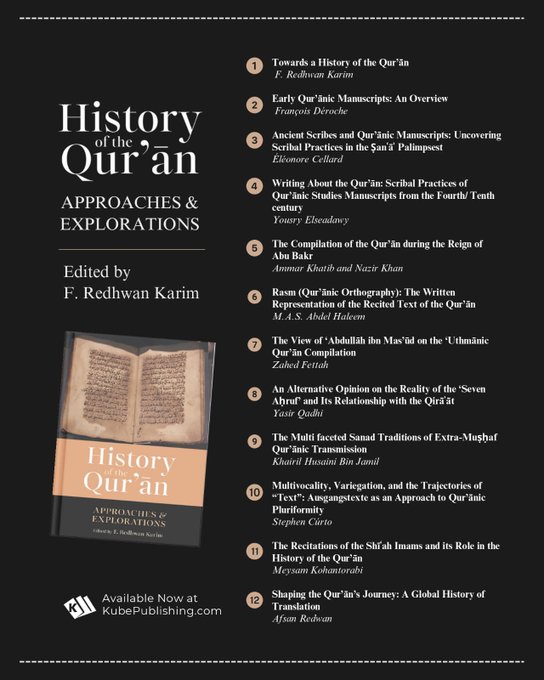
I’m excited to announce the release of my new article, which delves into early Qurʾānic manuscripts featuring a fully developed diacritical system. The article explores a key manuscript, its production context, and its distinctive diacritical features. Published in Déroche, François, eds. The Qurʾan and Its Handwritten Transmission, (Leiden, The Netherlands: Brill, 09 Dec. 2024)
I’m thrilled to announce that I’ve been awarded a grant from the Max van Berchem Foundation in Geneva. Thanks to this grant, I’ll be able to pursue my research on early Qur’an manuscripts, written in Kufic script, in Moroccan Libraries. A huge thank you to the Max van Berchem Foundation for its support and trust!
On Monday 15th July, I will give a lecture on Inks and Parchment in early Qur’anic fragments kept in Paris, Bibliothèque nationale de France, Arabe 328. These analyses have been done in collaboration with CRC’s scientists, Anne Michelin, Oulfa Belhadj and Sylvie Tao.